

Ancient Woodlands Ireland
An All-Island Inventory of Ancient and Long-Established Woodlands for Ireland
About
Ireland’s ancient woodlands (areas believed to have remained continuously wooded since at least 1660) are irreplaceable habitats of high biodiversity value. These woodlands can also provide additional ecosystem services, and often contain features of historical and cultural significance. Despite their importance, ancient woodlands are now a rare and fragmented feature on the island of Ireland.
Ancient Woodlands Ireland is a four-year research project funded by the Department of Agriculture, Food and the Marine (DAFM) and the National Parks and Wildlife Service (NPWS). The project is a collaboration between Maynooth University, Teagasc, Dundalk Institute of Technology and the Woodland Trust Northern Ireland.
Our project builds on previous work from the Provisional Inventory of Ancient and Long Established Woodland in Ireland. Ancient Woodlands Ireland is a multidisciplinary project. Researchers in Teagasc will use novel machine learning approaches to digitize woodland cover from historic maps. Historians on the team will delve deeper into manuscript maps and written records of land cover in Ireland from the 16th to the 19th century. Our paleoecologists will use preserved pollen in soil cores to reconstruct vegetation history and determine woodland age at sites of conservation importance. Ecologists and microbiologists will investigate whether certain plants and soil microorganisms can be used as indicators of ancient woodland in Ireland. Together, this work will deliver an all-island inventory of ancient woodlands in Ireland.
Ultimately, the Ancient Woodlands Ireland project will provide valuable data that can be used to enhance the protection of Ireland’s ancient woodlands and help prioritize sites for ancient woodland restoration.

Project Partners


News
Ancient Woodlands Ireland palaeoecology field season 2026
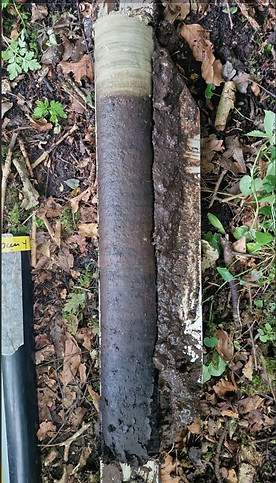
We’re nearing the end of our Ancient Woodlands Ireland palaeoecology field season. It’s been a wonderful few months visiting over 30 beautiful woodland sites in the last two field seasons. Amazing old oaks in places such as Breen Oak Wood NI, mixed woodland in sites such as Annagh Lough in Co. Cavan, and Duntally in Co Donegal. We have focussed on some sites known to be ancient, and some where the evidence is less clear, or sites too small to be included in the previous inventories. A big thank you to all those site owners and managers who helped us with access and coring, showing us around or suggesting sites. It was intensive fieldwork, so if we did not get to you this year, we will be out again in the spring, and any good days this autumn and look forward to catching up with you in the future.We have accumulated lots of lovely soil cores from these possible ancient woodlands. We now have lots of prepping, investigating chronologies through radiocarbon dating, and pollen microscopy work in the lab to look forward to over the coming months! Will the sites have continuous records of woodland cover? What species were there in the past? The detective work begins!Conference season for Ancient Woodlands Ireland
Conference season for Ancient Woodlands Ireland
It’s been a busy few months for the Ancient Woodlands Ireland team.
Back in February, DKIT PhD student Luke McMahon presented some of his research on archival evidence for woodland antiquity at the Irish History Students Association Conference at Maynooth University.
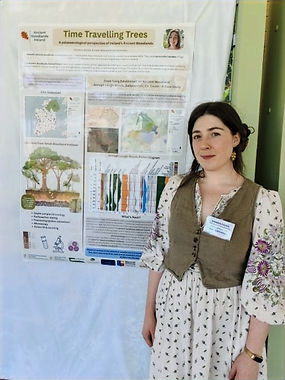
In April, Maynooth University PhD student Emmeline Cosnett introduced some of her paleoecology research at the Botanical Society of Britain and Ireland Spring conference at the National Botanic Gardens in Glasnevin.
Emmeline at the BSBI conference in the National Botanic Gardens
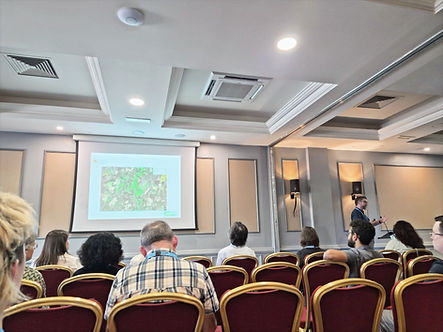
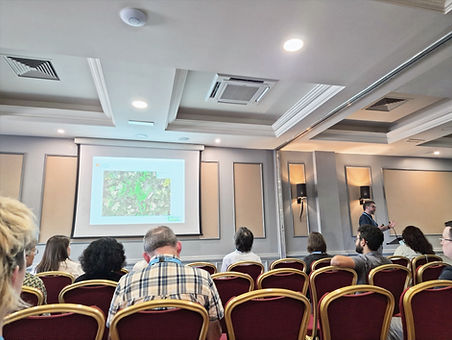
In May, we were off to the Agriculture and Land-Use conference in Portlaoise where Dr Jesko Zimmerman provided an update on a newly developed high resolution map of 1830s woodland cover for Ireland.
Jesko presenting Teagasc's woodland mapping research at the Agriculture and Land-Use conference in Portlaoise.
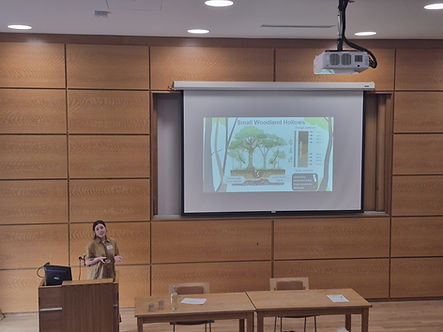
Emmeline was back in the Botanic Gardens in June for the Irish Plant Science Annual Meeting to give an update on the palaeoecological approaches used in the Ancient Woodlands Ireland project and was awarded the “Best Natural History talk” prize. Well done Emmeline!
Emmeline at the IPSAM conference, National Botanic Gardens


Team
Ancient Woodlands Ireland is a multidisciplinary project involving Maynooth University, Dundalk Institute of Technology, Teagasc, and the Woodland Trust Northern Ireland.

John received a PhD in Forest Ecology from University College Cork and has completed Post Doctoral Fellowships at the Smithsonian Institution and Trinity College Dublin. John leads the Forest Ecology & Global Change Lab at Maynooth University. John also currently serves as the coordinator of the IUFRO working party on Forest Biodiversity and Resilience. John is the Principal Investigator of the Ancient Woodlands Ireland project and will lead research on indicators of ancientness in Ireland's woodlands.

Helen is an experienced palaeoecologist who has undertaken research on long-term ecological dynamics of woodland. Her research seeks to understand long-term woodland ecology from the perspective of internal ecological dynamics and human influenced changes. For palaeoecologists long-term means thousands of years of change rather than hundreds as this provides and essential perspective for a full understanding of ‘ancient’ in ancient woodlands. Helen has worked in various roles and across disciplines to improve the long-term ecological information provided to land managers and policy-makers. Helen is leading the palaeoecology work on the Ancient Woodlands Ireland project.

Dr Carla Sa Ferreira
Post Doc, Maynooth University
I am a palaeoecologist with a background in Archaeology. I have a keen interest in past vegetation and climate dynamics, and in landscape evolution. I am interested in marginal and upland cultural land-use, tracing the origins of present-day landscapes and defining sustainable economic practices by analysing long-term vegetation evolution. I am also interested in how the knowledge of past vegetation dynamics can contribute to the restoration and sustainable management of sensitive ecosystems. I have participated in multiple palaeoenvironmental research projects in Portugal, Scotland and Ireland. In the “Ancient Woodlands Ireland” project I will be using a palaeoecological multiproxy approach to verify the presence and composition of ancient woodlands.

Emmeline is an experienced ecologist and botanist who joined the Ancient Woodlands Ireland palaeoecology team at Maynooth University in January 2026. Emmeline has worked in a variety of terrestrial and aquatic environments carrying out independent published research on botany and pollination ecology as well as working with agri-environmental schemes and completing a wide range of wildlife and habitat surveys across Ireland and Northern Ireland over the last 5 years in a professional environmental consultancy environment. Emmeline is completing her PhD as part of the AWI team, going back in time through the ‘pollen record time machine’ in order to better understand the environmental and vegetation dynamics that have shaped our woodlands today. She is particularly interested in ancient woodland indicator species and phytosociological perspectives.

Prof Fiona Walsh
Professor, Maynooth University
Prof Walsh is the lead of the Antimicrobial resistance Research Centre at Maynooth University. Her team investigates how the microbial biodiversity of different biomes impact the antimicrobial resistome and how change impacts the microbial diversity. Prof Walsh will lead the soil microbiome analysis for the Ancient Woodlands Ireland project. DNA sequencing and bioinformatic comparisons of woodland soils will be used to investigate if they contain microbial signatures specific to ancient soils.

Dr Eamon Darcy
Maynooth University
Eamon Darcy is a historian of early modern Ireland. His research focuses on Irish cultural, political, and social history from c.1550 until c. 1700 within a broader Atlantic World, British, and European framework. He is also editor of Archivium Hibernicum. As part of this project, Dr Darcy will co-supervise a PhD student in HIstory alongside Dr Annaleigh Margey, DKIT. This will lead to the production of an inventory of ancient Irish woodlands as identified from archival evidence that survives across Britain and Ireland.

Dr Annaleigh Margey
Dundalk institute of Technology
Annaleigh Margey is a historian of early modern Ireland. She received her PhD in History from the University of Galway and has held postdoctoral fellowships at Trinity College Dublin, University of Aberdeen, Institute of Historical Research, London and Maynooth University. Her research focuses on Irish history and historical geography from c.1540-1650. As part of this project, Dr Margey will co-supervise a PhD student in History with Dr Eamon Darcy, MU. This will lead to the production of an inventory of ancient Irish woodlands as identified from archival evidence that survives across Britain and Ireland.

Luke McMahon
PhD student, Dundalk Institute of Technology
Luke McMahon is a PhD researcher working on the Ancient Woodlands Ireland project. He received his Masters in History from the University of Galway, with a focus on the Early Modern period. He is co-supervised by Dr Annaleigh Margey and Dr Eamon Darcy for the Ancient Woodlands Ireland project looking to produce an inventory of ancient Irish woodlands as identified from archival evidence that survives across Britain and Ireland.

Dr Jesko Zimmermann, Teagasc
Jesko is a Data Technologist in the Agrifood Business and Spatial Analysis Department. Before joining Teagasc Jesko was a researcher at Trinity College Dublin with a background in environmental sciences.
In particular his interests lie in applied spatial analysis, land use dynamics, greenhouse gas emissions and mitigation options in agriculture, the circular bioeconomy, as well as ecology and biodiversity.
Jesko is leading WP2 in the Ancient Woodlands Ireland project, responsible for extracting long-established woodlands from the historic OS maps.

Areesha Asghar, Teagasc
Areesha Asghar is a skilled Geospatial Data Analyst, currently contributing her expertise to Teagasc in Dublin, Ireland. At Teagasc, Areesha's responsibilities include digitization of historic maps and identification of ancient woodlands in Ireland using machine learning techniques. Her professional experience is distinguished by her work with the Food and Agriculture Organization of the United Nations, where she played a pivotal role in advancing geospatial data management and analysis across various environmental and agricultural projects at national level. Areesha holds a Master’s degree in Remote Sensing and GIS from National University of Sciences and Technology, Pakistan.

Paul Armstrong
Public Affairs Manager, Woodland Trust
Paul joined the Woodland Trust in 2021 as Public Affairs Manager, where he leads the organisation’s policy, evidence, and advocacy work in Northern Ireland. The Woodland Trust is the UK’s leading woodland conservation charity, dedicated to protecting and restoring ancient woodlands, and planting trees to fight climate change and support wildlife. In 2007, the Woodland Trust launched the ‘Back on the Map’ project, which created a Northern Ireland Ancient Woodland Inventory. Paul will contribute to the project sharing data from the Back on the Map project, enhancing its impact in Northern Ireland and beyond.